Phu Quoc fish sauce is a Vietnamese nước mắm made on Phu Quoc island from anchovies salted at sea and aged 12–15 months in wooden barrels. Protected as a geographical indication in Vietnam since 2001 and in the EU since 2012, it is a benchmark for fish-sauce-based dips and seasonings.
For importers and brand owners, the name “Phu Quoc” is more than a place of origin. It is a legally protected designation with its own raw-material, process and bottling rules, which shapes how fish sauce products from Vietnam can be described, labelled and sold abroad.
1. Origins: where does Phu Quoc fish sauce come from?
It comes from Phu Quoc island in southern Vietnam, where fish sauce has been made for more than 200 years, according to the Vietnam Government News portal and Nhân Dân (9 July 2025). Production is concentrated in the Dương Đông and An Thới areas of the island.
The island was long part of Kien Giang province. Under Vietnam’s 2025 provincial reorganisation, Kien Giang and An Giang were combined into a single province named An Giang, with Phu Quoc becoming a special zone, as described by the An Giang provincial portal.
1.1. How did the craft become organised and protected?
Producers have worked collectively for decades. Báo Văn hóa (27 May 2021) reports that a producers’ syndicate was formed in 1939, which became the Phu Quoc Fish Sauce Producers Association in 2000.
Legal protection followed. Vietnam’s intellectual property office granted geographical indication (GI) protection in 2001, and the EU registered the name as a Protected Designation of Origin (PDO) on 8 October 2012, the first Vietnamese product to receive that status. Certificates were presented to producers at a ceremony on the island on 19 August 2013. In 2021, the Ministry of Culture, Sports and Tourism added the craft to Vietnam’s national intangible cultural heritage list.
2. How is Phu Quoc fish sauce made?
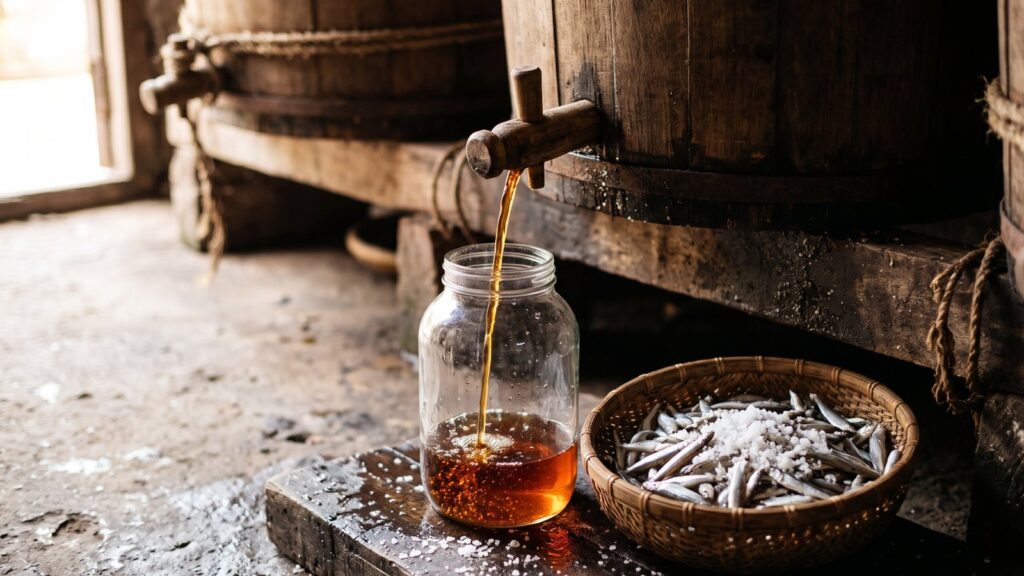
It is made by fermenting only anchovies (cá cơm) with salt in wooden barrels, with nothing else added. Fishermen salt the catch on the boat immediately after it is landed, typically at about three parts fish to one part salt; the GI standard’s traditional ratio is 2.5–3 parts fish to one part salt, according to Đại biểu Nhân dân (1 October 2026).
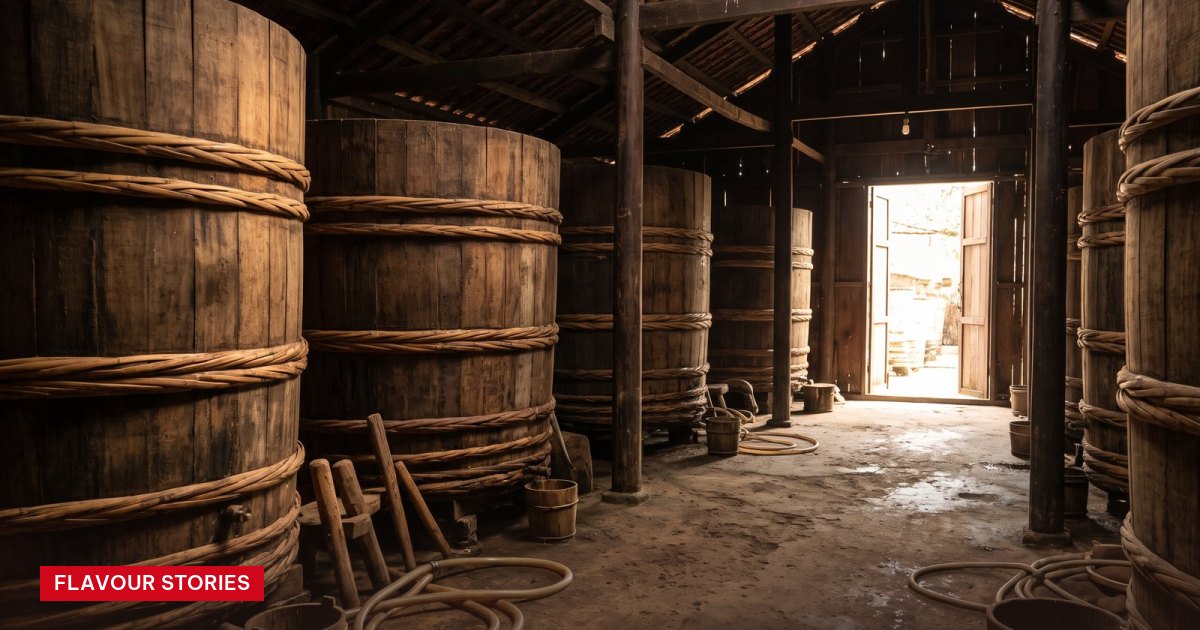
The salted fish then ferments naturally for 12–15 months on average in tall barrels made of bời lời and vên vên timber, bound with rattan hoops. Some barrels stand nearly three metres high. VnExpress (22 July 2016) reports that producers ferment for at least 12 months and that, to qualify for the GI, bottling must follow a closed process on the island.
- Fish: anchovy varieties from local waters, such as cơm phấn, cơm than and sọc tiêu (VnExpress).
- Strength: the sauce is graded in “độ đạm” (protein degrees); traditional methods can reach 30–43 degrees under ideal conditions.
- Scale: about 50 association members operate more than 7,000 barrels, producing roughly 20–30 million litres a year (Nhân Dân, 2025).
- GI-labelled volume: 21 enterprises sold more than 759,600 litres under the GI label in 2024, up from nine enterprises and 318,600 litres in 2014.
3. Flavour and how it is used
3.1. What does Vietnamese fish sauce taste like?
Good Vietnamese fish sauce tastes rounded and briny rather than simply salty or fishy, with strong umami. Vietnam’s national tourism site describes it as amber-brown and rich, with well-aged versions showing sweetness, mineral or caramel notes. A few drops are often enough to season a dish.
In the kitchen it works as seasoning, braising liquid and, above all, the base of dipping sauces. Fresh rolls are dunked in fish sauce mixed with sugar and lime juice, fried spring rolls take a version diluted with vinegar and water, and bún thịt nướng (grilled pork with rice noodles) is served with fish sauce mixed with garlic, sugar and vinegar. The garlic itself can shape a dip, as the story of Ly Son garlic, grown in sand on a volcanic island shows. Regional taste varies: the same source notes that northerners prefer it rich and salty, while southerners add more sugar. One wrapper with a story of its own is the dew-wetted rice paper of Trang Bang in Tây Ninh.
3.2. Key facts at a glance
| Item | Detail |
|---|---|
| Region | Phu Quoc island (Dương Đông, An Thới), southern Vietnam |
| Raw materials | Anchovies (cá cơm) and salt only |
| Fish-to-salt ratio | 2.5–3 : 1 (traditional GI ratio) |
| Fermentation | 12–15 months on average, in bời lời / vên vên wooden barrels |
| Flavour | Briny, rounded umami; aged lots may show sweet or caramel notes |
| Typical uses | Dipping sauces, seasoning, braising |
| Protection | Vietnam GI (2001); EU PDO (2012) |
| Heritage | National intangible cultural heritage (2021) |
4. From traditional kitchen to packaged product
Fish sauce is the backbone of many packaged Vietnamese condiments, from ready-mixed dipping sauces to marinades and hotpot bases. Turning that flavour into a shelf product raises practical questions that buyers should settle before the first order.
- Use the name correctly. “Phu Quoc” is reserved for registered producers meeting the GI rules, including bottling on the island. A blended sauce or dip made elsewhere should not imply Phu Quoc origin on the front label.
- Specify the fish sauce grade. Agree the protein degree, salt level and source of the fish sauce used as an ingredient, and ask for test results per batch so the flavour stays consistent.
- Plan for natural variation. Long-fermented fish sauce varies by lot. A ready-mixed dip needs a standard recipe and sensory check to absorb those differences.
- Match the pack to the market. Glass bottles suit premium retail, while pouches, sachets or bulk suit food service. Our guide to choosing packaging for sauces compares the options.
- Check destination labelling. Confirm each market’s rules for declaring fish as an allergen and for origin statements before the label artwork is finalised.
CiCook manufactures pure fish sauce, such as its anchovy fish sauce, and ready-mixed garlic-chilli fish sauce dips under OEM, ODM and private label, among the groups listed on its contract-manufactured product range. Its facility is registered with the US FDA and certified to ISO 22000:2018, with a COA issued for every batch.
Northern Vietnam has its own jar-and-sun tradition in Ban soy sauce, a soybean ferment from Hung Yen, which raises similar origin questions for brands. In the Mekong Delta, mam ca linh, a flood-season freshwater fish paste, shows how much less standardised a regional ferment can be.
Fish sauce marinades often lean on aromatics too; our story on lemongrass in Vietnamese marinades and soups explains how cooks prepare it.
FAQ
Is Phu Quoc fish sauce protected in the EU?
Yes. The EU registered the name as a Protected Designation of Origin in 2012, the first Vietnamese product to gain that status, so the name is protected across EU member states.
Can any Vietnamese fish sauce be called Phu Quoc fish sauce?
No. Only registered producers on Phu Quoc who follow the geographical-indication rules, including island anchovies, wooden-barrel fermentation and bottling on the island, may use the name.
Planning a fish-sauce-based dip or seasoning for your market? Contact CiCook’s private-label team or message us on WhatsApp at +84 813 378 398.
References
- Vietnam Government News / VNA (20 August 2013): Phu Quoc fish sauce makers receive EU’s PDO certificate
- Viet Nam News – Bizhub (17 July 2013): Phu Quoc fish sauce granted PDO in EU
- Nhân Dân (9 July 2025): Giữ gìn nghề nước mắm truyền thống Phú Quốc
- Báo Văn hóa (27 May 2021): Nghề làm nước mắm ở Phú Quốc trở thành di sản văn hóa phi vật thể quốc gia
- Đại biểu Nhân dân (1 October 2026): Bên trong những thùng gỗ khổng lồ ở Phú Quốc
- VnExpress (22 July 2016): Cách nhận diện nước mắm Phú Quốc
- Vietnam National Authority of Tourism (accessed 22 October 2026): Fish sauce: Vietnam’s first love
- An Giang Provincial Portal (2025): Steering committees conference on reorganising An Giang and Kien Giang
Compiled and edited by the CiCook editorial team from the sources listed under References. For information only; please check the original documents before making business decisions.