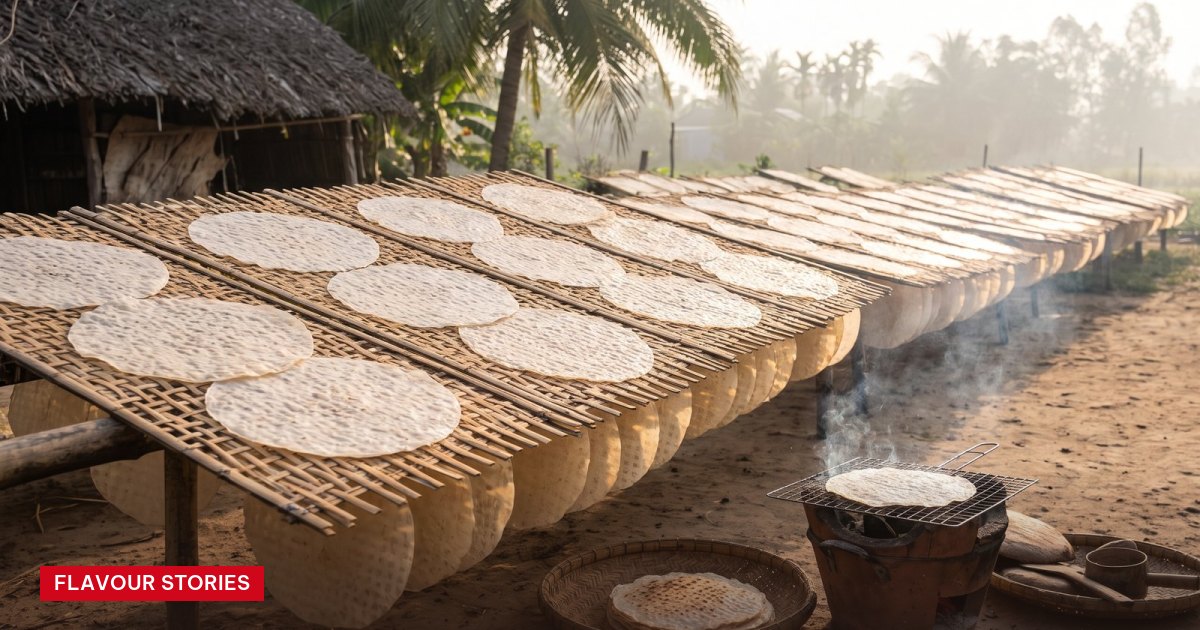
Trang Bang rice paper (bánh tráng phơi sương) is a salty, soft rice paper from the Trảng Bàng area of Tây Ninh province. Makers steam rice batter, sun-dry it, toast it over burning peanut shells and leave it out in the night dew, so it can be eaten without soaking.
Most rice paper sold abroad is a brittle, translucent disc that has to be dipped in water before rolling. The version made around Trảng Bàng, in southern Vietnam, takes the opposite route: it is softened by the weather itself. This story looks at where the craft comes from, how it is made, how it is eaten and what it teaches anyone turning a regional rice product into a packaged one.
1. Where does Trang Bang rice paper come from?
Trang Bang rice paper comes from the Trảng Bàng area of Tây Ninh province, with Lộc Du hamlet often named as its home. In April 2016 the craft of making it was recognised as a National Intangible Cultural Heritage, and the provincial People’s Committee honoured 11 craftspeople at the ceremony, Việt Nam News reported.
Accounts of its age differ. At the 2016 ceremony, the director of the provincial culture department said Vietnamese settlers learned the craft from the area’s earlier inhabitants, calling it “a mainstay of Tây Ninh’s culinary culture”. A 2018 Việt Nam News report dates the tradition to the 13th century. The province has since held festivals around it: the first ran from 6 to 12 April 2016, and a second culture and tourism week opened on 20 December 2018.
2. How is dew-wetted rice paper made?
Dew-wetted rice paper is made in stages that end outdoors at night. Published descriptions agree on the core sequence, though they differ on details such as drying time.
- Choose and soak the rice. Newly harvested, good-quality rice is preferred; local strains named include Bằng Cóc, So Miên and Nàng Miên. The rice is soaked for 4–6 hours and ground in water.
- Season with salt, not sugar. A moderate amount of salt gives the paper its slightly salty taste; cassava flour may be mixed into the rice flour.
- Steam on cloth. The batter is spread thinly on cloth stretched over a pan of boiling water, producing a thin rice crepe.
- Sun-dry on bamboo racks. One 2023 account says about an hour while still damp; a 2018 report says two days. Too long makes it brittle, too short leaves it tough.
- Toast over peanut shells. Sheets are lightly toasted over a peanut-shell fire until small bubbles form and the colour turns milky white.
- Expose to the night dew. The toasted sheets sit on long bamboo racks until they absorb enough dew to turn soft, then are bagged with pieces of banana leaf to stay supple.
The dew stage is the one locals consider most important, and the hardest to standardise: how long the sheets stay out depends on how much dew falls that night. Some steps are now supported by machines, and many families now specialise in a single stage rather than the whole process.
3. Flavour and how it is used
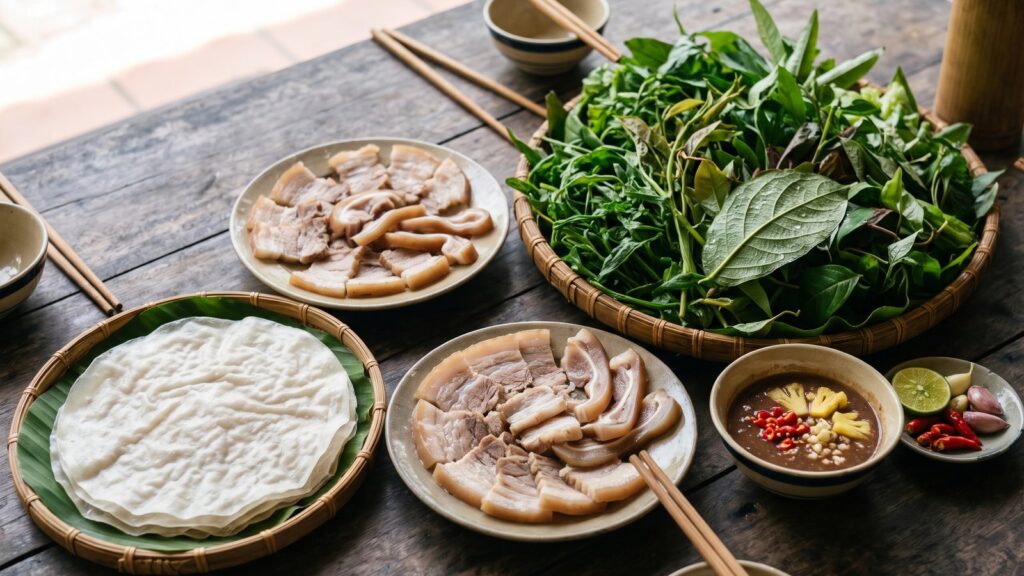
Trang Bang rice paper tastes lightly salty and feels soft and slightly gummy, with a bubbled surface and two thin layers. Because the dew has already rehydrated it, it is rolled straight from the pack around boiled pork or veal, grilled fish and plates of wild vegetables and herbs. In Tay Ninh, rice paper snack sellers often pair it with Tay Ninh shrimp salt, the local chilli-shrimp dip.
Rice paper rolls like these are commonly served with a sweet-and-sour fish sauce, so the dip matters as much as the wrapper. That links the dish to two staples covered earlier on this site: how Phu Quoc fish sauce is made in wooden barrels and the volcanic-island garlic used in Vietnamese dips.
The table below sets the dew-wetted style against the dry rice paper most importers already know, using only the sources listed at the end.
| Key fact | Trang Bang dew-wetted rice paper | Standard dry rice paper |
|---|---|---|
| Region | Trảng Bàng area, Tây Ninh province, southern Vietnam | Varies by producer |
| Main ingredients | Rice flour (may include cassava flour), salt, water; no sugar | Rice flour, tapioca flour, salt, water |
| Final step | Toasted over peanut shells, then softened by night dew | Sold as thin, crisp, dried sheets |
| Texture and flavour | Soft, slightly gummy, lightly salty, bubbled surface | Translucent and crisp until rehydrated |
| How it is eaten | Straight from the pack, rolled with pork, fish and herbs | Dipped briefly in hot water before rolling |
| Recognition | National Intangible Cultural Heritage (craft), 2016 | Not applicable |
4. From traditional kitchen to packaged product
Can a dew-softened rice paper travel? The craft itself shows the challenge: makers bag the soft sheets with banana leaves precisely because moisture is what makes them good. For brands and importers developing a rice paper line, a few practical points follow. The raw material matters too: a briefing on Vietnam rice exports and 2026 price trends tracks the market behind the rice.
- Pick the format first. A soft, ready-to-roll sheet behaves very differently on the shelf from a dry sheet, so moisture-barrier packaging and shelf-life testing need to be planned from the brief, not after sampling.
- Write the recipe into the specification. Rice type, rice-to-tapioca ratio, salt level, sheet size, shape (round or rectangular) and thickness all change how the paper rolls and tastes.
- Use place names honestly. Call a product “Trang Bang” or “dew-wetted” only if it is made that way and there, and check the origin-claim rules of each destination market.
- Think in pairs. Rice paper is eaten with a dip, so a matching dipping sauce can turn a commodity wrapper into a meal kit.
CiCook makes rice paper, rice vermicelli and dipping sauces for private-label brands at a dedicated rice-products factory, one of its three factories. Its facility is registered with the US FDA and certified to ISO 22000:2018.
FAQ
Do you need to soak Trang Bang rice paper before eating it?
No. Dew-wetted Trang Bang rice paper is already softened by the night dew, so it is rolled straight from the pack. Standard dry rice paper, by contrast, is dipped briefly in water first.
What is the difference between dew-wetted and regular rice paper?
Dew-wetted rice paper is salted rather than sweetened, toasted over peanut shells and softened outdoors by dew, giving a soft, bubbled sheet. Regular rice paper is sold as thin, dry, translucent sheets that need rehydrating.
Planning a rice paper or dipping sauce line under your own brand? Send your brief to the CiCook team or message us on WhatsApp at +84 813 378 398.
References
- Việt Nam News (7 April 2016): Rice paper gets heritage status
- Việt Nam News (22 December 2018): Rice paper festival opens
- Asia News Network / Việt Nam News (26 December 2023): The meticulousness process to make Trang Bang dew-soaked rice paper
- Bac Ninh Newspaper (22 December 2018): Trang Bang dew-wetted rice paper honoured
- Wikipedia (accessed 30 October 2026): Bánh tráng phơi sương
Compiled and edited by the CiCook editorial team from the sources listed under References. For information only; please check the original documents before making business decisions.