
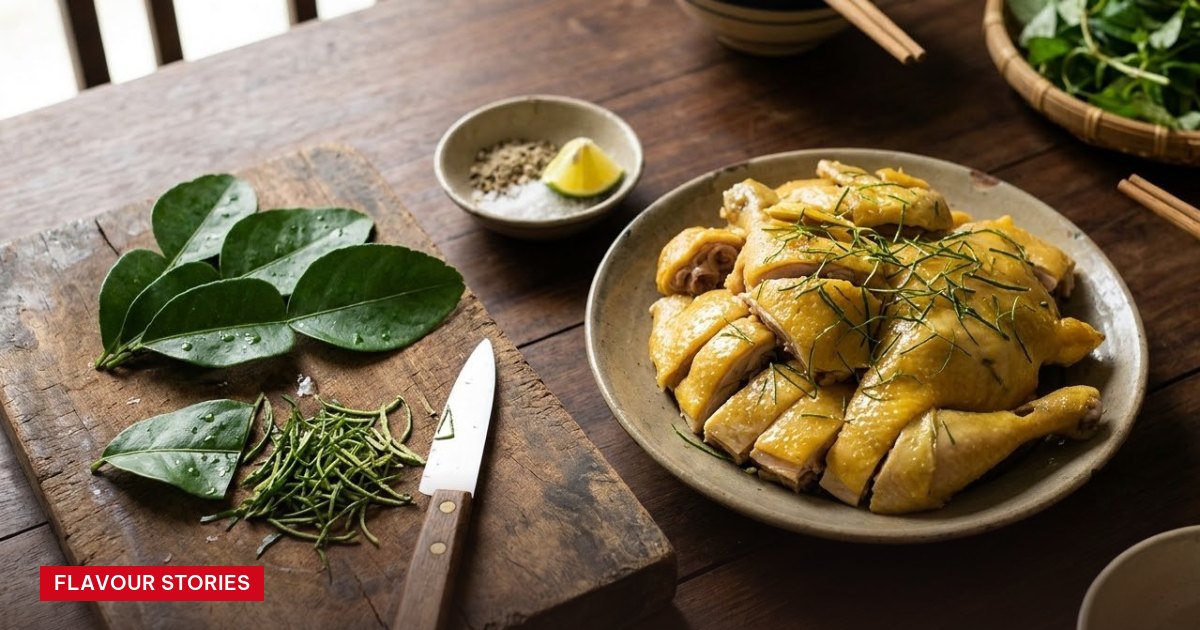
In Vietnamese cooking, lime leaves (lá chanh) are a fragrant herb: shredded thread-fine over boiled chicken, crushed into marinades or wrapped around grilled chicken. They are used sparingly, since too much turns a dish bitter, and because the name only means “lime leaf”, sauce developers should specify the citrus species.
1. Why is boiled chicken eaten with lime leaves?
Boiled chicken is served with lime leaves because the leaf’s mild essential oil lifts the aroma of the meat, and the pairing has become a fixed part of the dish. VnExpress Cooking, in an explainer published on 14 August 2024, notes that many diners consider gà luộc without lime leaves only half as good.
The habit is old enough to live in a children’s rhyme (đồng dao). As quoted by VTC News, it opens with “Con gà cục tác lá chanh”: the hen clucks for lime leaves, the pig grunts for spring onion, and the dog begs for galangal. Each animal names the herb it is traditionally cooked with, which makes the rhyme a small folk recipe book.
The same VTC article asks why cooks reach for lime leaves rather than pomelo or orange leaves, and attributes the choice to the leaf’s high essential-oil content. That aroma is the whole point: the leaf is not eaten for bulk but as a seasoning.
2. Which lime leaf is meant: key lime or makrut?
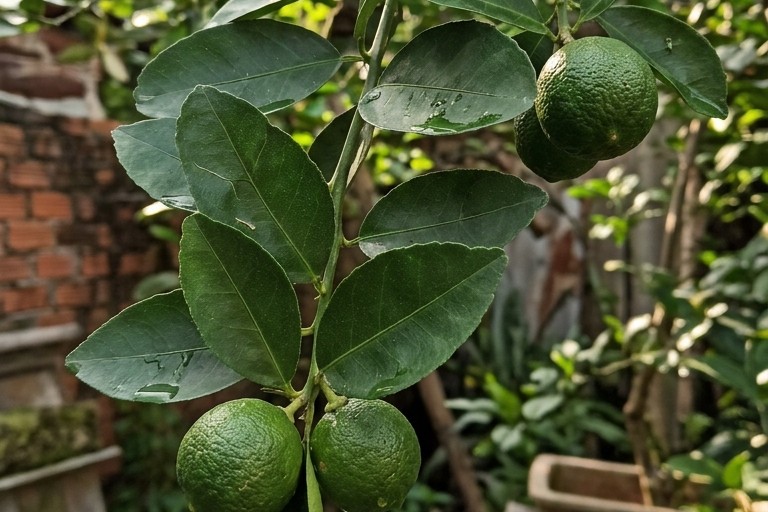
The Vietnamese name does not say, so buyers should ask. Lá chanh literally means “lime leaf”. The everyday lime in Vietnam, chanh ta, is Citrus aurantifolia, the species a 2025 review in the Thu Dau Mot University science journal examines; Encyclopaedia Britannica calls it the key or Mexican lime.
Makrut lime is a different species, Citrus hystrix, which Britannica also lists as Thai lime and says flavours Southeast Asian cuisines through its fruit and leaves. The Royal Horticultural Society describes its glossy, dark green leaves as coming “in two parts” and gives its native range as Southeast Asia.
For the key lime, the Thu Dau Mot review reports a leaf essential-oil yield of 0.3–0.8% of sample mass and names limonene as the main compound of the leaf and peel oils, at 29.7–77.5% across the studies it reviewed. For a product brief, the practical lesson is simple: write the botanical name, not just “lime leaf”.
3. Flavour and how it is used
Lime leaves give Vietnamese chicken dishes a fresh citrus fragrance, and cooks use them in three main ways: as fine shreds sprinkled on at the end, crushed or torn into a marinade or poaching liquid, and as a wrapper on the grill. VnExpress Cooking warns that a heavy hand makes the dish bitter, so the leaf should support the meat, not mask it.
- Gà luộc (boiled chicken): a light scattering of thread-fine shreds over the sliced bird, served with salt, pepper and lime.
- Gà rang lá chanh (dry-fried chicken): a VnExpress Cooking recipe of April 2023 crushes about two thirds of 10 leaves into the marinade for half a hen and saves the rest, finely cut, for the finish.
- Gà khô lá chanh (dried shredded chicken): breast meat is poached with crushed leaves, shredded, stir-fried with lemongrass and chilli and dried; the January 2022 recipe calls for 30–40 leaves in total.
- Grilled chicken skewers: in a recipe published by Viet Nam News from a chef at the Metropole Hanoi, shredded leaves season the marinade and each piece of chicken is wrapped in a whole leaf before charcoal grilling.
Beyond chicken, VnExpress Cooking lists chicken phở, snail dishes, stir-fried silkworm pupae and nem tai (pork-ear salad) among the dishes that use shredded lime leaves.
3.1 How do Vietnamese cooks shred lime leaves so finely?
They choose mid-branch leaves that are neither young nor old, dry them well, remove the tough midrib, roll them tightly and slice across the roll in one smooth stroke. According to VnExpress Cooking, young leaves are less fragrant and wilt fast, old leaves are fibrous, and a sharp, heavy knife on a firm wooden board matters most; cutting at 45 degrees gives longer strands.
| Key fact | Detail | Source |
|---|---|---|
| Vietnamese name | Lá chanh (“lime leaf”) | VnExpress Cooking, 2024 |
| Common lime in Vietnam | Chanh ta, Citrus aurantifolia (key or Mexican lime) | Thu Dau Mot University journal, 2025; Britannica |
| Different species often confused | Makrut or Thai lime, Citrus hystrix, leaves in two parts, native to Southeast Asia | Britannica; RHS |
| Key lime leaf oil | Yield 0.3–0.8%; limonene the main compound of leaf and peel oils | Thu Dau Mot University journal, 2025 |
| Classic dishes | Boiled chicken, dry-fried chicken, dried shredded chicken, grilled chicken skewers, nem tai | VnExpress Cooking; Viet Nam News |
| Leaf to choose | Mid-maturity leaves, even, not curled or insect-damaged | VnExpress Cooking, 2024 |
| Main risk in use | Too much leaf makes the dish bitter | VnExpress Cooking, 2024 |
4. From traditional kitchen to packaged product
Lime leaves in Vietnamese cooking are about aroma and restraint, and both are easy to lose when a home recipe is scaled up. A brand developing a chicken marinade, a dipping salt or a dried-chicken snack can use these checks:
- Name the species. Put Citrus aurantifolia or Citrus hystrix on the specification and make the ingredient list match what is actually used.
- Decide the leaf’s job. Crushed leaves in a marinade or poaching liquid give background aroma; visible shreds signal the dish to the buyer. Many recipes use both, as the dry-fried chicken recipe above does.
- Agree leaf maturity with the supplier. Home cooks reject young, old, curled or damaged leaves, and incoming material can be checked against the same standard.
- Set the dose by sensory testing. Bitterness is the known failure point, so run small trial batches before fixing the formula.
- Keep folk remedies off the label. Old cookbooks and popular articles credit the leaf with health benefits; a food label should describe flavour, not health effects.
Lime leaves rarely work alone: the recipes above pair them with shallot, ginger, chilli and lemongrass, which is covered in our story on lemongrass in Vietnamese cooking. For a brighter citrus note in seafood dips, Vietnamese cooks turn to fruit instead, as in kumquat-based seafood dipping sauces.
CiCook’s three factories make dipping sauces, BBQ sauces and marinades under OEM, ODM and private-label agreements. Every batch ships with a COA, and customer formulas are protected by NDA.
FAQ
Can makrut lime leaves replace Vietnamese lime leaves?
Makrut is a different species, Citrus hystrix, with a distinctive two-part leaf. It can give a lime-leaf aroma, but test it in sensory trials before switching and name the species correctly on the label.
How many lime leaves go on boiled chicken?
Only a light sprinkle of fine shreds, because too much makes the dish bitter. As a guide, one published dry-fried chicken recipe uses 10 leaves for half a hen.
Planning a sauce or marinade built on Vietnamese herbs? Send us your product brief or message us on WhatsApp +84 813 378 398.
References
- VnExpress Cooking (14/08/2024): Vì sao gà luộc ăn kèm lá chanh?
- VTC News (15/09/2021): Ẩm thực Việt: Sự thật thú vị sau những câu đồng dao ăn uống mà ai cũng thuộc
- VnExpress Cooking (25/01/2024): Mẹo thái lá chanh nhỏ hơn sợi chỉ
- VnExpress Cooking (03/04/2023): Cách làm gà rang lá chanh cho ngày giao mùa
- VnExpress Cooking (06/01/2022): Cách làm gà khô lá chanh
- Viet Nam News (undated): Chicken skewers with lime leaves
- Tạp chí Khoa học Đại học Thủ Dầu Một (27/05/2025): Tổng quan về hiệu suất, thành phần hóa học và hoạt tính sinh học của tinh dầu chanh ta
- Encyclopaedia Britannica (accessed 20/11/2026): Lime
- Royal Horticultural Society (accessed 20/11/2026): Citrus hystrix, makrut lime
Compiled and edited by the CiCook editorial team from the sources listed under References. For information only; please check the original documents before making business decisions.