
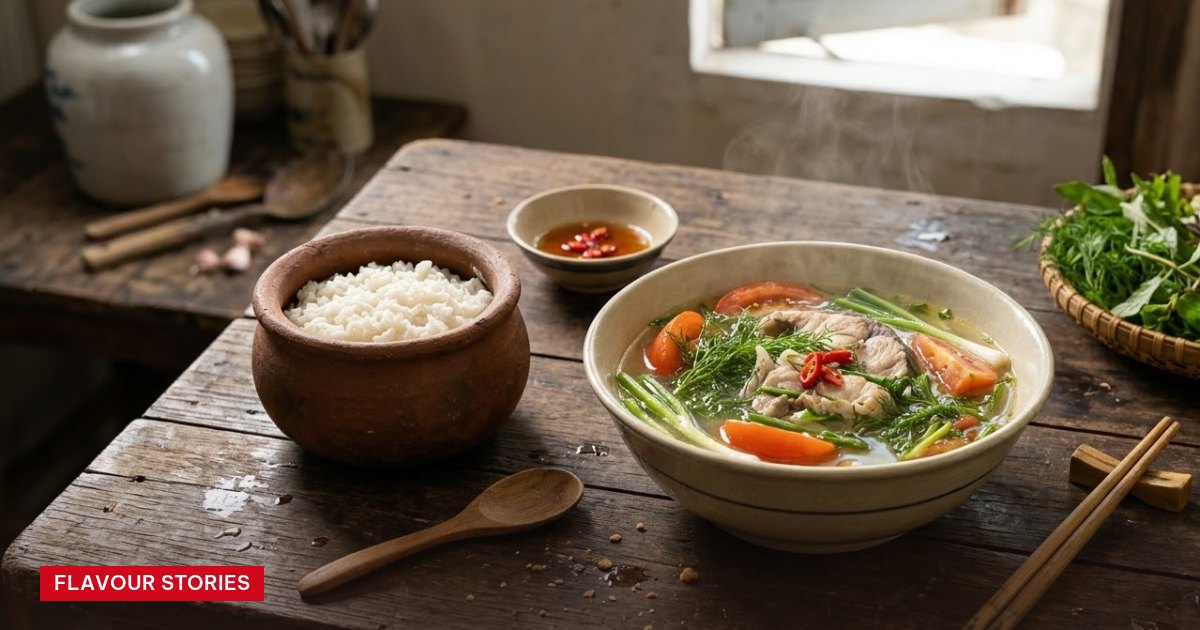
Mẻ is a sour paste made by fermenting cooked plain rice with a starter (mẻ cái) from an earlier batch. Used mainly in northern Vietnam, it gives a mild, rounded sourness and gentle aroma to crab and fish soups, snail and eel stews, galangal marinades and dipping sauces.
Ốc om chuối đậu, the old-Hanoi stew of snails, green banana and tofu, owes much of its character to a spoonful of mẻ. The condiment is little known outside Vietnam, yet it does a job every Vietnamese kitchen needs done: it supplies the sourness that balances fish, snails, eel and rich meats. This story looks at where mẻ comes from, how it is used, and what changes when a jar-kept kitchen ferment moves towards a packaged product.
1. What is mẻ and where does it come from?
Mẻ, also called cơm mẻ, is cooked rice left to ferment until it turns into a thick, off-white, mildly sour paste. VOV (19 June 2026) explains that lactic acid bacteria, yeasts and other microbes convert the starch in the rice into organic acids and aroma compounds, which is where the sourness and smell come from.
Mẻ belongs above all to the cooking of Hanoi and the northern delta. An Ninh Thủ Đô describes it as a fixture of Hanoi dishes such as snail and banana stew, and notes that households either buy a starter at the market or get one from a family that keeps a jar going.
1.1 How is mẻ made at home?
Mẻ is made by layering cooled cooked rice over a starter and letting it ferment under a cloth rather than a lid for days or weeks. The traditional method reported by An Ninh Thủ Đô runs like this:
- Put the starter (mẻ cái) at the bottom of a glazed clay jar.
- Cover it with plain cooked rice that has cooled completely.
- Do not seal the jar; cover it with a cloth instead.
- After about two to three weeks the rice turns milky white and slightly sour, and the mẻ is “ngấu” (matured).
- To keep the culture alive, take out the matured mẻ and add fresh cooled rice.
Timing varies widely. VOV says fermentation takes from a few days to a few weeks depending on conditions, while a 2024 study in the Czech Journal of Food Sciences lists 7–10 days for a sour rice paste bought in a Hanoi market. That spread is the first thing anyone turning mẻ into a product has to deal with.
2. Flavour and how it is used
Mẻ tastes gently sour rather than sharp, with a distinct fermented aroma. A 2001 VnExpress essay on Hanoi sour soups puts the difference neatly: soup soured with cơm mẻ is less clear than one made with fermented rice-wine vinegar (dấm bỗng), but it smells fragrant and its sourness is soft and mild.
2.1 Which dishes use mẻ?
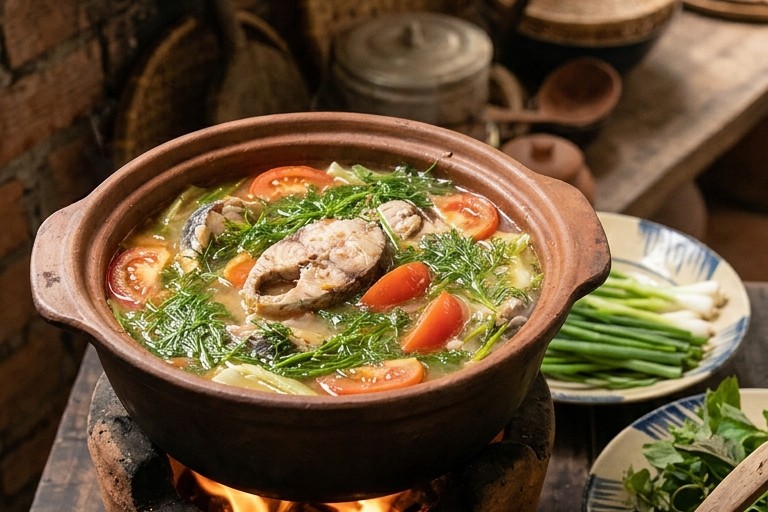
Mẻ is used in northern stews, soups, marinades and dips. In riêu soups it takes the place of sour fruit (An Ninh Thủ Đô), and VnExpress lists it among the souring options for Hanoi sour fish soup, alongside sấu, tai chua and dấm bỗng. Typical uses named in the sources include:
- Stews: ốc om chuối đậu (snails with green banana and tofu), eel and frog stews, giả cầy pork stew and braised fish (cá om).
- Soups: bún riêu cua and fish riêu soups.
- Marinades: grilled pork or braised fish with galangal and mẻ.
- Dips: mẻ chưng, mẻ cooked with tomato and eaten with raw vegetables.
Mẻ usually works with partners. In the VnExpress recipe for old-Hanoi snail stew, matured mẻ is pushed through a sieve until smooth and combined with mắm tôm, northern Vietnam’s fermented shrimp paste. Its other classic partner is galangal: An Ninh Thủ Đô names grilled pork and braised fish marinated with galangal and mẻ. The rhizome’s wider uses are covered in our story on galangal’s role in Vietnamese cooking.
2.2 Mẻ at a glance
| Aspect | What the sources say |
|---|---|
| Region | Northern Vietnam, especially Hanoi cooking |
| Base | Plain cooked rice plus a starter (mẻ cái) |
| Fermentation time | A few days to a few weeks (VOV); about 2–3 weeks (An Ninh Thủ Đô); 7–10 days for a Hanoi market sample (Czech J. Food Sci., 2024) |
| Ready when | Milky white, thick paste, mildly sour |
| Flavour | Soft, rounded sourness with fermented aroma; cloudier broth than vinegar |
| Typical uses | Riêu soups, sour fish soup, snail and eel stews, galangal marinades, mẻ chưng dip |
| Home storage | Clean covered container, kept cool or refrigerated (VOV) |
| Alternatives in soups | Sấu, tai chua, dấm bỗng (VnExpress, 2023) |
3. From traditional kitchen to packaged product
Turning mẻ into a shelf-stable ingredient means replacing a living, variable jar culture with a controlled process. For brands that want a northern sour note in a soup base, stew sauce or marinade, these points matter most:
- Standardise the fermentation. The sources disagree on timing by weeks, so a product needs a fixed starter, rice type, temperature and end point, checked by measured acidity rather than by smell.
- Treat raw mẻ as a microbial risk. The 2024 Czech study identified Bacillus cereus as the one isolate it recovered from its mẻ sample. A validated heat step and clear supplier specifications are needed before mẻ goes into a sealed pack.
- Screen out spoiled batches. VOV warns against mẻ with mould, an off smell or changed colour or texture; in a factory these become rejection criteria at goods-in.
- Control texture. Home cooks sieve mẻ before use. Milling to a smooth paste helps it disperse in sauces and avoids grainy sediment in jars or pouches.
- Explain it to export buyers. Mẻ is unfamiliar outside Vietnam, so specifications and labels should describe it plainly as fermented rice and state its function as a souring agent.
Mẻ-soured profiles sit naturally beside the hotpot bases, dipping sauces and marinades in our product range. CiCook runs three factories for seasonings, foods and rice-based products, certified to ISO 22000:2018 and HACCP, and develops formulas under OEM, ODM or private label with NDA protection.
FAQ
Is mẻ the same as cơm rượu?
No. Mẻ is a sour paste fermented from plain cooked rice with a mẻ starter. Cơm rượu is sweet, alcoholic fermented glutinous rice made with a yeast cake (bánh men), as described in a 2024 Cần Thơ University study.
What can replace mẻ in Vietnamese sour soup?
VnExpress lists sấu (dracontomelon), tai chua (garcinia slices) and dấm bỗng (fermented rice-wine vinegar) as alternatives for Hanoi sour fish soup. They give a clearer, sharper sourness, without mẻ’s fermented aroma.
Developing a soup base or sauce with a northern Vietnamese sour profile? Talk to our product development team or message us on WhatsApp +84 813 378 398.
References
- VOV (19/06/2026): Mẻ là gì mà được xem là “bí quyết tạo vị chua” trong nhiều món ăn Việt?
- An Ninh Thủ Đô (10/11/2019): Những món ăn nổi danh được làm từ… mẻ
- VnExpress (19/05/2023): Cách làm canh chua cá Hà Nội
- VnExpress (09/05/2024): Cách làm ốc om chuối đậu kiểu Hà Nội cũ
- VnExpress (20/10/2001): Canh chua Hà Nội
- Czech Journal of Food Sciences (12/2024): Diversity of cultivable lactic acid bacteria and bacilli in traditional fermented foods in Vietnam, 42(6): 435–446
- Tạp chí Khoa học Đại học Cần Thơ (2024): Khảo sát chất lượng và phân lập nấm men, nấm mốc từ cơm rượu được sản xuất ở thành phố Cần Thơ
Compiled and edited by the CiCook editorial team from the sources listed under References. For information only; please check the original documents before making business decisions.