
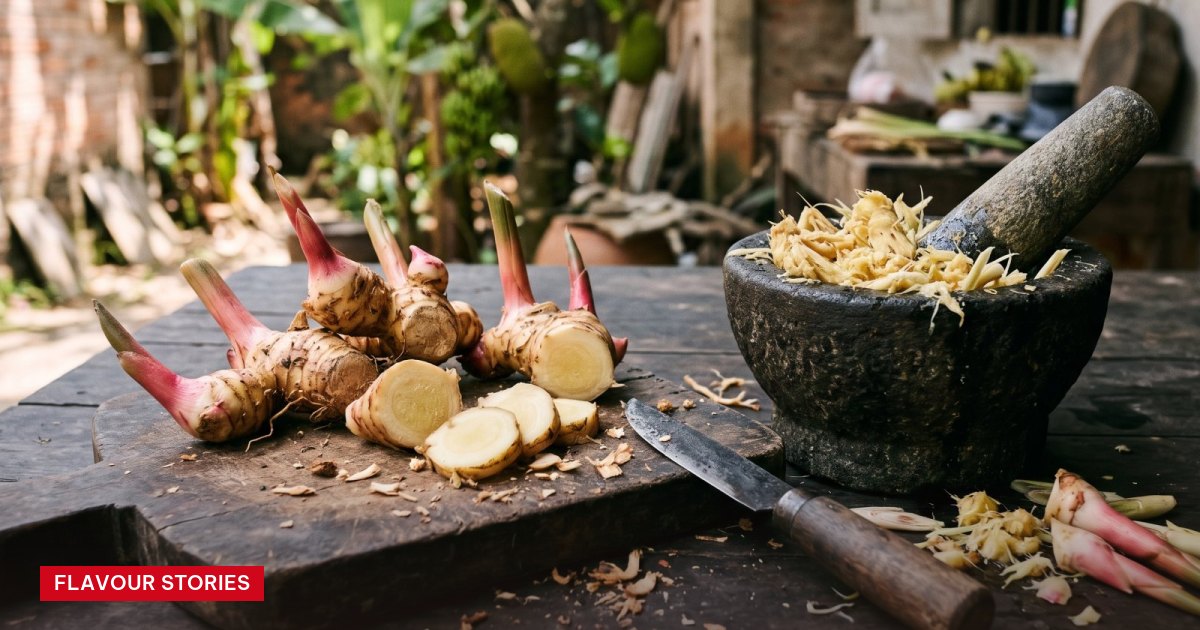
Galangal (riềng) is a pungent rhizome central to northern Vietnamese cooking. It flavours the turmeric marinade of Hanoi’s cha ca La Vong, the slow-braised fish of Vu Dai village and dishes eaten with shrimp paste. Vietnam uses two species, and sauce makers must choose between fresh, dried and paste forms.
1. What is galangal and where does it come from?
Galangal is the underground stem of a plant in the ginger family (Zingiberaceae), used mainly as a spice. According to the PROSEA plant resources profile, its exact origin is unknown: the oldest reports of its use come from southern China and Java, and today it grows cultivated or semi-wild near villages across South-East Asia, India, Bangladesh, China and Suriname.
Vietnamese cooks actually work with two species. Greater galangal (Alpinia galanga) is known in Vietnam as riềng nếp. Lesser galangal (Alpinia officinarum), called riềng or riềng thuốc, grows wild and cultivated in southern China and Indochina; PROSEA describes its rhizomes as more aromatic and pungent than those of the greater species.
Is galangal the same as ginger?
No. The two are relatives, but galangal tastes sharper. PROSEA describes its flavour as strongly pungent, like a mixture of black pepper and ginger, which is why Vietnamese recipes that call for riềng rarely swap it for ginger alone.
2. Flavour and how it is used
In Vietnam, galangal is above all a northern flavour, used to cut through rich fish and meat and to partner fermented seasonings. Three dishes show the pattern clearly. Further north-east, Lang Son cooks reach for a different aromatic to stuff whole roasts: mac mat leaves, the herb behind Lang Son roast pork and duck.
- Cha ca La Vong (Hanoi): fish fillets are marinated in galangal juice, turmeric, mẻ (fermented rice), pepper and fish sauce for at least two hours, then grilled over charcoal, as described by VnExpress and Tạp chí Công Thương. A 2023 VnExpress piece also lists shrimp paste among the marinade seasonings.
- Vu Dai braised fish: the village’s clay-pot fish is cooked with ginger, galangal, chilli, shallots, lime, fish sauce, sugar and salt; in the Tết season families start braising from the 20th day of the last lunar month (VnExpress, 30/1/2018).
- Dishes eaten with mam tom: in Hanoi’s vịt dấm ghém, diners pair duck and pork belly with herbs, a little peppery galangal and shrimp paste (VnExpress, 8/9/2023). Galangal also meets mam tom in the cha ca marinade, which ties riềng closely to northern Vietnamese shrimp paste.
When is galangal harvested?
For the spice market, greater galangal is harvested about three months after planting. PROSEA notes that rhizomes older than four months turn woody, fibrous and spongy and lose their value as a spice, while plants grown for essential oil are left more than seven months.
| Key fact | Galangal (riềng) |
|---|---|
| Botanical names | Alpinia galanga (greater, riềng nếp); Alpinia officinarum (lesser, riềng / riềng thuốc) |
| Origin | Exact origin unknown; earliest records from southern China and Java |
| Characteristic flavour | Strongly pungent, like pepper mixed with ginger; lesser galangal is more aromatic |
| Harvest for spice | About 3 months after planting; older than 4 months becomes woody and fibrous |
| Forms traded | Fresh or dried; ground galangal is not traded in bulk because of adulteration risk |
| Signature Vietnamese uses | Cha ca La Vong marinade, Vu Dai clay-pot fish, dishes served with mam tom |
| US status | Galanga root listed as “generally recognized as safe” (GRAS 2498) |
3. From traditional kitchen to packaged product
Turning a galangal-led marinade or dipping sauce into a shelf product starts with decisions a home cook never has to make. These points help brands brief a manufacturer clearly.
- Name the species and form. Greater and lesser galangal differ in strength, so the specification should state which one, and whether the formula uses fresh rhizome, dried slices or a paste.
- Control rhizome age. Because over-mature galangal turns fibrous, agree a sensory and texture check at intake, especially for sauces with visible pieces.
- Prefer whole or sliced material. PROSEA warns that ground galangal can be adulterated, for example with the other species; grinding whole material under your own controls reduces that risk.
- Plan for the partners. Recipes that pair galangal with shrimp paste carry crustacean ingredients, so check FDA allergen labelling for Asian sauces before exporting to the United States.
- Test the balance after processing. Pungent rhizome notes can shift during heating and storage, so taste pilot batches at the end of the intended shelf life, not only on day one.
CiCook makes private-label marinades, dipping sauces and hotpot bases in a US FDA-registered facility certified to ISO 22000:2018. Customer formulas are protected by NDA.
FAQ
Can ginger replace galangal in Vietnamese recipes?
Not exactly. Galangal tastes like pepper mixed with ginger, so ginger alone lacks its sharp, peppery edge. Dishes such as cha ca La Vong rely on galangal for their character.
Which Vietnamese dishes use galangal?
Mostly northern dishes: Hanoi’s cha ca La Vong, the clay-pot braised fish of Vu Dai village and dishes eaten with mam tom, such as vịt dấm ghém.
Developing a sauce built on Vietnamese aromatics? Contact our manufacturing team or message us on WhatsApp +84 813 378 398.
References
- PROSEA / Pl@ntUse (accessed 9/11/2026): Alpinia galanga
- PROSEA / Pl@ntUse (accessed 9/11/2026): Alpinia officinarum
- VnExpress (5/9/2013): Thơm mãi vị chả cá Lã Vọng
- Tạp chí Công Thương (28/9/2020): Chả cá Lã Vọng có từ bao giờ?
- VnExpress (8/9/2023): Mắm tôm trong món ăn Hà Nội
- VnExpress (30/1/2018): Làng Vũ Đại đỏ lửa kho cá phục vụ dịp Tết
- Tạp chí Công Thương (7/9/2016): Làng cá kho Vũ Đại
Compiled and edited by the CiCook editorial team from the sources listed under References. For information only; please check the original documents before making business decisions.